




KANGAROO VALLEY OUTHOUSE
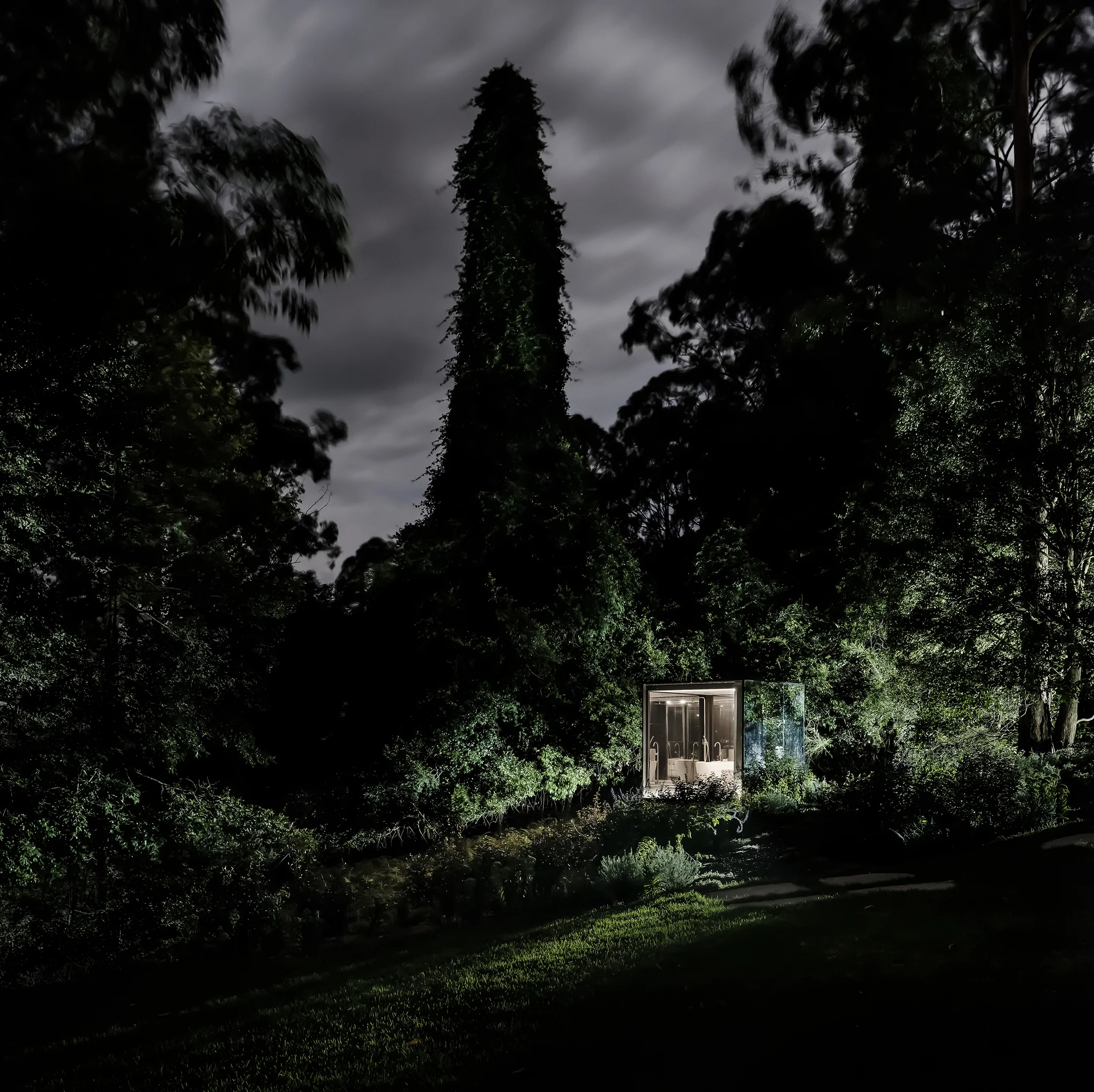
Set low on a hillside, some thirty metres from a simple cabin, "Kangaroo Valley Outhouse" is a structure that comes and goes with the light. The intention was to separate bathing from sleeping and, in doing so, recapture something of the experience of camping: the walk through bushland, the warmth of sunlight or the cool of the night under a vast sky, and the sense of being far beyond the city, always outdoors as the day moves through its small rituals from light to dark.
A path winds through dense planting to reach the outhouse, a mirrored cube raised just above the ground and held within the vegetation. Resisting the temptation of an intrusive form, it does not impose on its setting but reflects it. By day it all but disappears, mirroring the bush so completely that only the fine lines of its edges remain legible.
Inside, the experience is reversed. The walls are one-way mirror, reflective from without and entirely transparent from within, so that the bath and shower at the centre of the cube sit in uninterrupted view of the surrounding bush. At night, when the interior is lit, the glass becomes transparent from the outside as well. It is rare to find a site with no concern for privacy, and the design embraces that freedom. Bathing here is an experience of complete exposure, yet the remoteness of the siting means no one is there to see, leaving only a heightened awareness of place, and of being at once vulnerable within the untamed landscape and part of it. The walk down the path, particularly after dark, deepens that sense of immersion.
Achieving true invisibility demanded careful resolution with the engineer. The large sheets of mirrored glass, their fixings, the elevated structure and its waterproofing each presented challenges, while the ground was subtly reshaped to form the path and conceal the supporting columns.
The budget was considered with the same clarity. Investment was concentrated in the outhouse and the precision of its disappearing act, while the existing cabin, designed by others, was deliberately left raw and basic. It is the contrast between the two that shapes the experience as a whole.
The outhouse touches the ground lightly and is fully demountable, allowing the site to be returned to its natural state at any time. Natural ventilation, solar-powered lighting and a greywater and septic system further reduce its footprint.
For those who stay, the client's wish for retreat has been realised: a place to escape, unwind and remain connected to the land.
Traditional Custodians: The Wodi Wodi people of the Dharawal Nation
Photography: Robert Walsh
Team: Madeleine Blanchfield and Kevin Ewart